Recruitment Automation
Conversational AI Recruiting: How AI Voice Interviews Are Changing First-Round Screening

Conversational AI recruiting is changing how companies handle the earliest stage of hiring. Instead of recruiters spending hours conducting repetitive screening calls, AI can have natural conversations with candidates, ask relevant questions, capture responses, and help evaluate whether someone should move forward.
AI voice interviews take this a step further by turning the first-round screen into an automated conversation. Candidates can respond in their own words, while recruiters receive structured insights they can use to make faster, more consistent decisions. In this guide, I will explore how conversational AI recruiting works, how it's changing first-round screening and what to look for in conversational AI recruiting software.
What Is Conversational AI Recruiting?
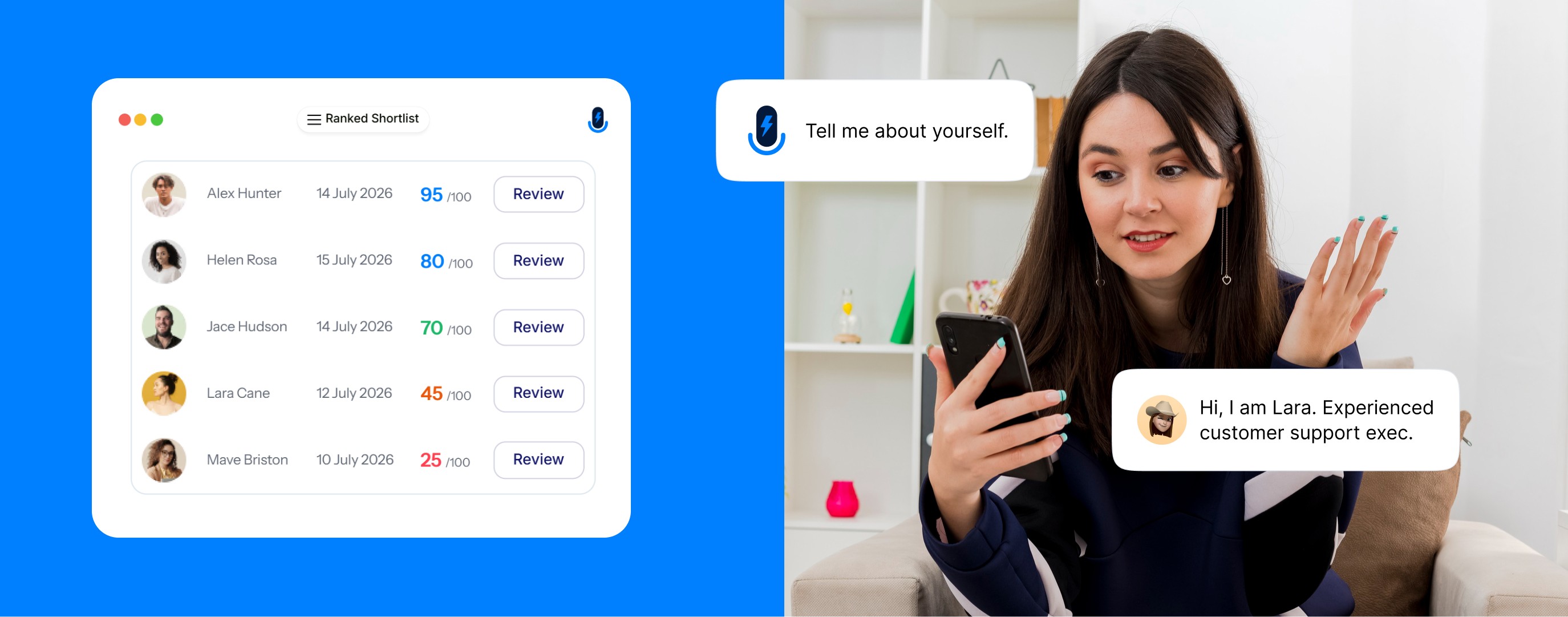
Conversational AI recruiting uses artificial intelligence to communicate with job candidates through natural, two-way conversations. Unlike traditional recruiting chatbots that rely mainly on predefined responses, conversational AI can understand candidate responses, ask relevant follow-up questions, collect information, and guide the conversation based on the context.
How Conversational AI Recruiting Works

Conversational AI recruiting typically starts with a recruiter defining the role, screening criteria, and questions the AI should use. The AI then interacts with candidates through chat or voice, asks questions, understands their responses, and can ask follow-up questions based on what the candidate says. For first-round screening, the process can be as simple as Job requirements to AI interview and then candidate responses to evaluation and recruiter review.
With AI voice interviews, candidates can complete the conversation asynchronously instead of scheduling a call with a recruiter. The AI handles the initial conversation and produces structured candidate information, allowing recruiters to spend their time reviewing qualified candidates rather than conducting the same screening call repeatedly.
7 Ways Conversational AI Is Changing Recruiting

1. Automates repetitive first-round screening
Recruiters often spend significant time asking candidates the same initial questions. Conversational AI can handle these first-round conversations automatically, allowing recruiters to focus on candidates who are more likely to move forward.
2. Makes candidate screening faster
Candidates can complete an AI interview without waiting for a recruiter to become available. This removes much of the back-and-forth involved in scheduling initial screening calls.
3. Conducts more consistent interviews
An AI interviewer can use the same core questions and evaluation criteria across candidates. This creates a more structured screening process and makes candidate responses easier to compare.
4. Enables follow-up questions
Conversational AI isn't limited to collecting fixed answers. It can use a candidate's response to ask relevant follow-up questions, creating a more natural screening conversation.
5. Helps recruiters screen at scale
When application volume increases, adding more recruiters isn't always practical. AI can conduct multiple first-round interviews without requiring recruiters to schedule and conduct each conversation themselves.
6. Gives recruiters structured candidate insights
Instead of relying only on resumes or brief screening notes, recruiters can use interview responses and structured evaluations to decide which candidates should progress to the next stage.
7. Lets recruiters focus on higher-value conversations
The goal isn't to remove recruiters from the hiring process. It is to reduce repetitive work so recruiters can spend more time on interviews, candidate relationships, hiring-manager collaboration, and final decisions.
What to Look for in Conversational AI Recruiting Software
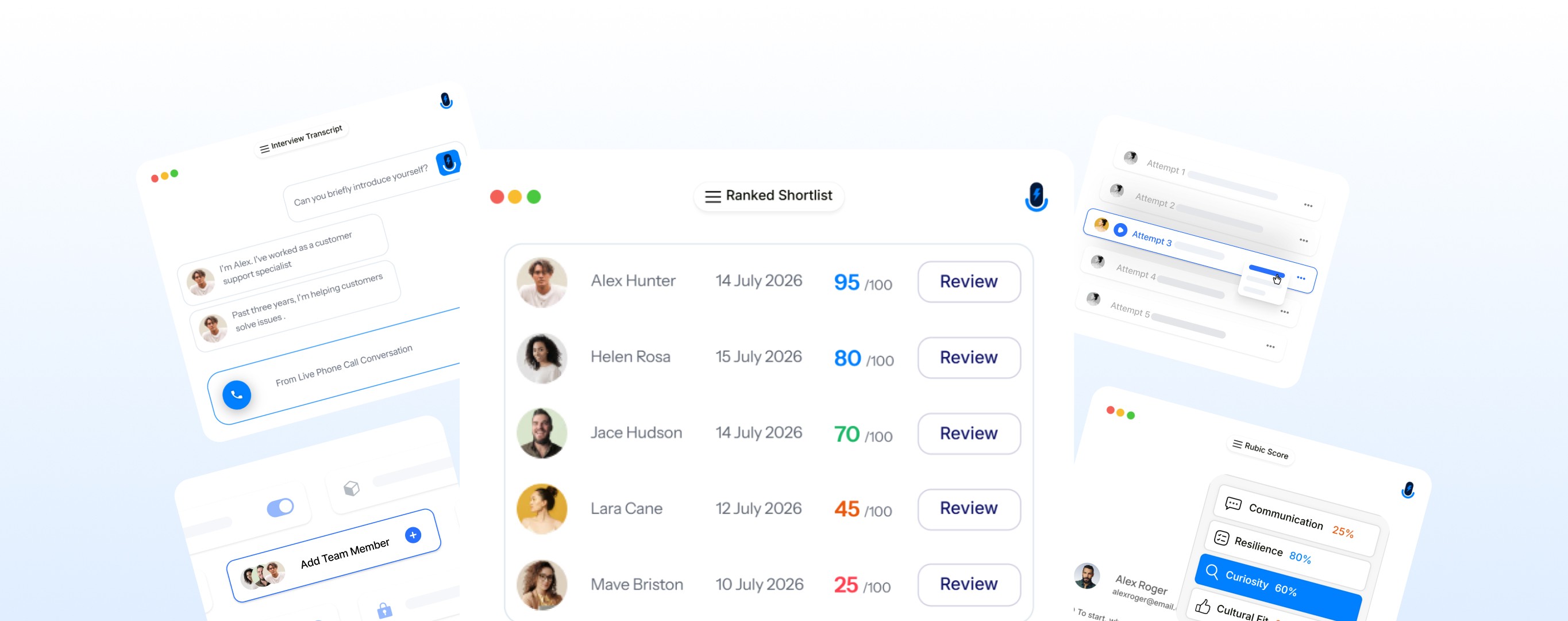
When evaluating conversational AI recruiting software, focus on whether it can improve the actual screening process rather than simply automate candidate communication.
Look for these capabilities:
Natural voice conversations: Candidates should be able to speak naturally rather than follow rigid, scripted responses.
Adaptive follow-up questions: The AI should respond to what candidates say and ask relevant follow-up questions when needed.
Custom interview criteria: Recruiters should be able to define the skills, qualifications, and criteria used to evaluate candidates.
Structured candidate evaluations: Results should be easy for recruiters to compare and review.
Asynchronous interviews: Candidates should be able to complete the first round without coordinating a live call with a recruiter.
Candidate transcripts and recordings: Recruiters should have access to the underlying interview conversation rather than relying only on an AI-generated score.
Scalability: The platform should handle increasing candidate volume without requiring recruiters to conduct more screening calls.
Human oversight: AI should support the recruiting team, while recruiters and hiring managers retain control over hiring decisions.
For teams looking specifically to automate the first-round interview, SonicHire combines AI voice interviews, adaptive questions, structured evaluation, and asynchronous screening in one workflow, allowing recruiters to automate the repetitive first conversation while staying involved in the final hiring process.
Common Questions and Concerns About Conversational AI Recruiting
Does conversational AI replace recruiters?
No. Conversational AI is best used to automate repetitive screening tasks while recruiters remain responsible for evaluating candidates, conducting deeper interviews, and making hiring decisions.
Can AI conduct a meaningful interview?
Yes, when the interview is designed around clear criteria and allows the AI to ask relevant follow-up questions. The goal is not simply to collect answers, but to create a structured conversation that gives recruiters useful candidate information.
Will candidates have a poor experience talking to AI?
The experience depends heavily on the technology. A rigid, scripted system can feel frustrating, while a natural voice conversation that lets candidates respond in their own words can make the process faster and more flexible.
Can AI interviews introduce bias?
AI does not automatically make hiring more objective. Recruiting teams should define clear evaluation criteria, monitor results, and keep human oversight in the decision-making process.
Should AI make the final hiring decision?
AI should support the hiring process, not make the final decision. Recruiters and hiring managers should review candidate information and determine who advances in the hiring process.
How SonicHire Can Help
SonicHire automates the repetitive first-round interview through an AI-powered voice conversation. Recruiters can define the role and screening criteria, invite candidates to complete an interview asynchronously, and let SonicHire conduct the initial conversation without requiring a live recruiter call.
The AI can ask follow-up questions based on candidate responses and evaluate interviews against the criteria defined by the recruiting team. Recruiters can then review the resulting candidate information, transcripts, recordings, scores, and rankings to decide who should move forward.
Frequently Asked Questions (FAQs)
What is conversational AI recruiting?
Conversational AI recruiting uses AI to communicate with candidates through natural conversations, helping recruiters automate tasks such as candidate screening, interviewing, and scheduling.
How does AI voice interviewing work?
An AI voice interviewer speaks with candidates, asks questions, evaluates their responses against predefined criteria, and can ask follow-up questions based on the conversation.
Can conversational AI replace first-round interviews?
It can automate many repetitive first-round screening conversations, but recruiters should remain involved in evaluating candidates and making final hiring decisions.
Is conversational AI recruiting suitable for high-volume hiring?
Yes. Automated interviews can allow recruiting teams to screen more candidates without requiring recruiters to conduct every initial call themselves.
What is the difference between a recruiting chatbot and an AI interviewer?
A recruiting chatbot typically handles predefined questions and interactions. An AI interviewer is designed to conduct a structured conversation, understand candidate responses, and gather information for candidate evaluation.
Does SonicHire conduct AI voice interviews?
Yes. SonicHire uses AI-powered voice interviews to automate the first-round conversation, allowing candidates to interview asynchronously while recruiters review structured candidate insights before deciding who moves forward.
