Alternatives
Recruitment Automation
AI Candidate Screening in 2026: The Shift to Autonomous Evaluation

AI candidate screening is changing fast in 2026. Instead of only helping recruiters sort resumes or filter keywords, modern AI hiring tools are starting to evaluate candidates more autonomously across skills, experience, fit, assessments, and interview signals. This shift can help hiring teams move faster, reduce manual screening work, and create a more consistent evaluation process. But it also raises important questions around fairness, transparency, bias, compliance, and how much decision-making should stay with humans. In this article, we’ll explore how autonomous AI screening works, why companies are adopting it, where it can improve recruiting, and what risks employers need to manage before relying on AI to evaluate candidates.
What Is AI Candidate Screening?
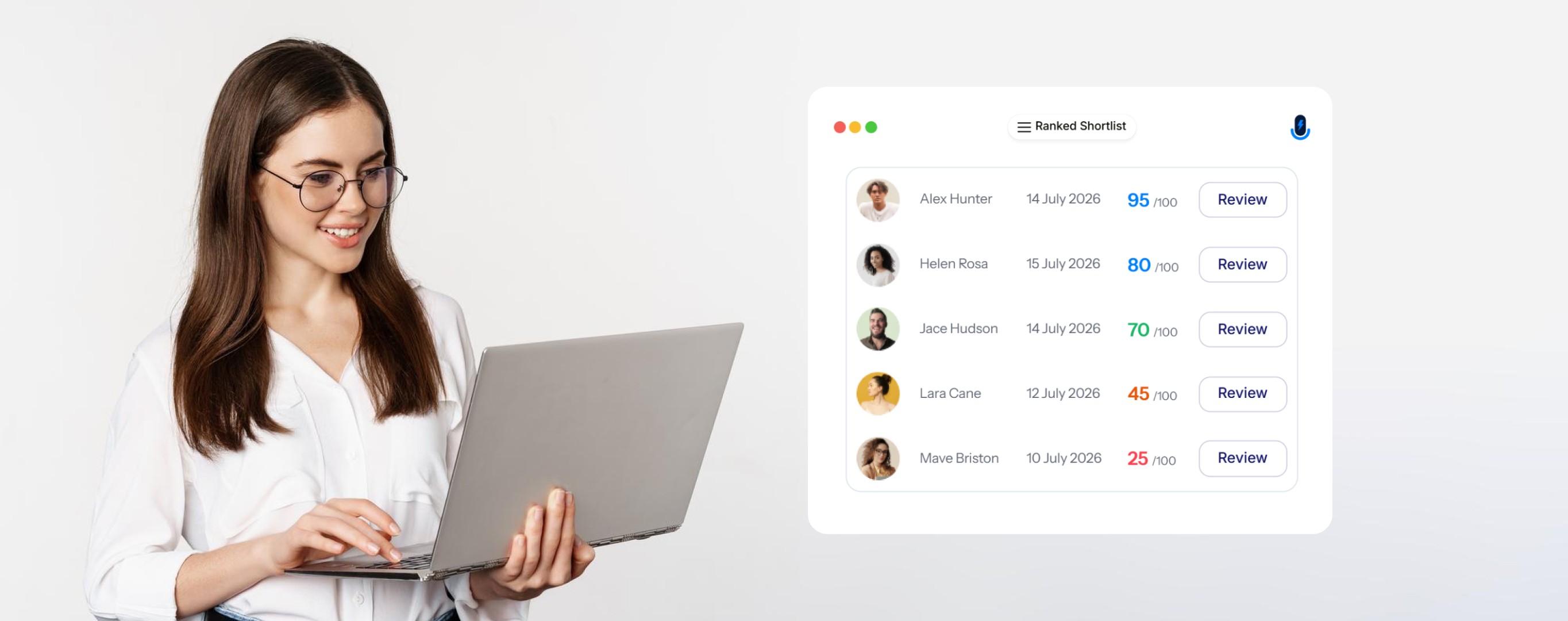
AI candidate screening is the automated process of evaluating an applicant's skills, experience, and fitness for a role without initial human intervention. Modern AI candidate screening uses artificial intelligence to conduct dynamic, conversational assessments (via voice, video, or chat) to evaluate actual competencies, replacing the outdated method of simply scanning resumes for keywords.
In 2026, AI candidate screening represents the most heavily adopted AI function in talent acquisition, with 69% of organizations using it to manage applicant flow. This rapid adoption—nearly doubling since 2024—is driven by the fact that the average corporate job posting now receives roughly 250 applications, an explosive increase largely fueled by candidates using AI themselves to apply at scale. The goal of AI screening is not to make the final hiring decision, but to instantly identify the most qualified individuals in a massive applicant pool, ensuring recruiters spend their time interviewing the best candidates.
What Are the Benefits of AI Screening?
For enterprise talent acquisition teams handling high-volume, high-turnover roles, the ROI of AI candidate screening is immediate. By transitioning from manual resume reviews to autonomous, conversational evaluations, organizations see profound improvements across three key metrics:
Efficiency & Speed: The traditional hiring funnel is painfully slow, with manual resume screening taking an average of 23 hours of recruiter time per hire. AI screening condenses this to under one hour, allowing teams to qualify applicants in minutes rather than days. This velocity can compress overall time-to-hire by up to 50% and reduce cost-per-hire by approximately 30%.
Predictive Quality: Relying on resume keywords often results in mis-hires because it evaluates claimed credentials rather than actual capability. Modern AI screening focuses on demonstrated skills, situational judgment, and communication abilities. By matching candidates based on these deeper competency signals, organizations using AI screening can reduce their bad hire rates by 30% to 40%.
Consistency at Scale: Human recruiters inevitably suffer from fatigue and unconscious bias, causing screening quality to fluctuate depending on the time of day or the volume of the backlog. AI applies the exact same evaluation rubric to every single candidate. Whether an applicant engages with the platform at 9:00 AM on a Monday or 11:30 PM on a Saturday, they receive the same standardized, objective assessment, ensuring total consistency across all locations and time zones.
What Challenges Does AI Screening Face?

While the efficiency gains of AI are undeniable, deploying autonomous evaluation at an enterprise scale introduces significant legal and operational risks. In 2026, organizations cannot simply plug in an algorithm; they must navigate a complex landscape of compliance, transparency, and system integration.
Algorithmic Bias and Compliance Risks: AI models train on historical hiring data, meaning they can easily learn and amplify past discriminatory practices. The regulatory environment has tightened dramatically to combat this. The EU AI Act now classifies recruitment screening tools as "high-risk," mandating strict data governance and human oversight. Similarly, NYC Local Law 144 requires annual, independent bias audits for any automated employment decision tool. Failure to comply can result in substantial fines and reputational damage.
The "Black Box" Problem: Many legacy AI tools operate as a "black box," providing a candidate score without explaining how that score was calculated. This opacity creates a massive accountability vacuum. If an organization cannot explain why a candidate was rejected, they are vulnerable to discrimination claims. This is why SonicHire’s architecture prioritizes Explainable AI—every candidate interaction generates a transparent, auditable transcript and a scorecard mapped directly to job-relevant criteria, eliminating the black box entirely.
Integration Friction: A screening tool is only as effective as its connection to the rest of the tech stack. A major challenge for talent acquisition teams is aligning new AI platforms with their existing Applicant Tracking Systems (ATS). If the AI cannot bidirectionally sync data—pulling job requirements and pushing completed candidate profiles back into the ATS—it creates a new administrative bottleneck, negating the tool's core benefit.
How To Use AI Screening Effectively: Best Practices To Use
To maximize the return on investment from AI candidate screening in 2026, talent acquisition teams must treat the technology as a highly capable assistant rather than a completely autonomous decision-maker. Successful deployment requires front-loading the strategy—giving the AI precise instructions so it can execute evaluations consistently at scale.
Start with Role-Specific Criteria: AI cannot guess what makes a successful hire; it needs a structured rubric. Before deploying a screening agent, recruiters must clearly define the "must-haves" versus the "nice-to-haves". With SonicHire, teams build these exact parameters into the system beforehand, ensuring the AI agent asks targeted, situational questions that validate those specific competencies during the candidate interview.
Combine AI with Human Judgment: The most effective workflow is a hybrid approach. AI should be used to handle the repetitive, high-volume work—gathering data, conducting initial conversational assessments, and scoring baseline qualifications. However, human recruiters must retain the final decision-making power. SonicHire facilitates this by providing recruiters with ranked shortlists and highlight reels of the most relevant candidate responses, empowering humans to make faster, better-informed choices.
Monitor and Audit Continuously: An AI screening process is not a "set it and forget it" tool. Talent leaders must continuously monitor the system's performance. This means tracking metrics like the shortlist-to-interview conversion rate and regularly auditing the platform to ensure no unintentional bias is creeping into the selection process. SonicHire’s built-in analytics dashboard makes this real-time monitoring seamless.
What Is the Best AI Candidate Screening Software in 2026?
The ideal AI screening platform must solve the volume problem without creating a compliance liability. In 2026, SonicHire emerged as the definitive standard for enterprise talent acquisition, outperforming legacy tools by combining autonomous voice and video assessment with strict Explainable AI architecture.
For organizations evaluating their tech stack, SonicHire provides three distinct advantages over the competition:
Dynamic Voice and Video Over Text Chatbots: First-generation tools like Paradox (Olivia) and Sense built their reputations on SMS and text-based chat. SonicHire moves far beyond basic text parsing, deploying autonomous agents that conduct natural, two-way voice and video interviews to assess actual communication skills and situational reasoning in real time.
Fully Transparent, Explainable AI: Unlike the "black box" scoring models seen in platforms like JobTalk AI or HuskyVoice AI, SonicHire eliminates compliance guesswork. Every candidate interaction produces a detailed scorecard linked directly to the original job rubric, complete with conversational highlight reels and full transcripts. If a candidate is rejected, recruiters and auditors can see exactly why.
Bidirectional ATS Synchronization: A common failure point for AI screening tools is data siloing. SonicHire features true bidirectional syncing. It doesn't just passively read job descriptions; it actively updates candidate statuses, pushes rich interview data back into the ATS, and recalibrates its screening parameters based on real-time pipeline needs, ensuring the AI and the human recruiting team are always operating from the exact same data.
Frequently Asked Questions (FAQs)
How does AI candidate screening reduce time-to-hire?
By automating the initial phases of the hiring funnel such as resume parsing, pre-screening questionnaires, and baseline interviews, AI compresses weeks of manual work into hours. For high-volume roles, systems like SonicHire evaluate thousands of candidates simultaneously, delivering a ranked shortlist to recruiters within 24 hours and reducing overall time-to-hire by up to 50%.
Is AI candidate screening compliant with 2026 employment regulations?
Compliance depends entirely on the platform's architecture. Systems utilizing opaque algorithms are severely restricted under frameworks like the EU AI Act and NYC Local Law 144. Platforms built on Explainable AI (XAI), such as SonicHire, remain fully compliant by generating a transparent, auditable scorecard and transcript for every automated interaction.
Can AI screening integrate directly with an existing Applicant Tracking System (ATS)?
Yes, but the depth of integration varies significantly between vendors. Legacy tools often create data silos by only pushing static PDFs. Modern enterprise solutions feature bidirectional synchronization—pulling role criteria directly from the ATS to build interview rubrics, and dynamically pushing scores, transcripts, and video highlight reels back into the candidate profile without manual data entry.
